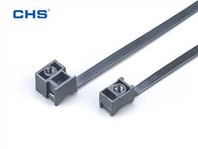
As a supplier of Holder Cable Ties, I've encountered numerous inquiries regarding the locking mechanism of our products. This blog post aims to delve into the intricacies of Holder Cable Ties' locking mechanisms, providing you with a comprehensive understanding of how they function and their advantages.
The Basics of Cable Tie Locking Mechanisms
Before we specifically discuss Holder Cable Ties, it's essential to understand the general concept of cable tie locking mechanisms. Cable ties, also known as zip ties, are used to bundle items together, primarily cables and wires. A locking mechanism is what ensures the tie remains securely fastened once it's tightened around the objects.
The most common type of locking mechanism in cable ties is the single - tooth ratchet system. In this system, the cable tie has a series of teeth on one side of the strap, and a pawl (a small, movable part) inside the head of the tie. As the strap is pulled through the head, the pawl engages with the teeth, allowing the strap to move in one direction (tightening) but preventing it from slipping back out.
Holder Cable Ties' Locking Mechanism
Holder Cable Ties feature a highly effective locking mechanism. Our ties are engineered with precision to provide a reliable and secure hold. The single - tooth ratchet design used in our standard Holder Cable Ties is similar to the industry norm, but with several key enhancements.
The teeth on our cable ties are carefully crafted to have a specific shape and pitch. This design allows for smooth insertion of the strap through the head during tightening while ensuring a firm grip once the desired tension is achieved. The pawl inside the head is made of a durable material that can withstand repeated use without losing its functionality. It engages with the teeth of the strap so tightly that it can resist vibrations and external forces that might otherwise cause the tie to loosen.


In addition to the standard single - tooth ratchet mechanism, we also offer Holder Cable Ties with more advanced locking systems. For example, our Double Locking Cable Ties have two sets of locking teeth and pawls. This double - locking feature provides an extra layer of security, making them ideal for applications where a higher level of stability is required. Whether it's in industrial settings with heavy machinery vibrations or in outdoor installations exposed to harsh weather conditions, these double - locking ties ensure that your cables stay bundled together.
Another innovative option in our product line is the Dual Lock Cable Ties. These ties combine the traditional ratchet mechanism with an additional locking feature. The dual - lock design not only provides a strong initial hold but also has a secondary locking mechanism that can be activated if needed. This added security makes them suitable for critical applications where cable management is of utmost importance.
Advantages of Holder Cable Ties' Locking Mechanisms
One of the significant advantages of our locking mechanisms is their reliability. We understand that in many industries, such as electrical, automotive, and telecommunications, the integrity of cable management is crucial. A loose cable tie can lead to cable damage, short circuits, or even safety hazards. Our Holder Cable Ties' locking mechanisms are tested rigorously to ensure that they can maintain a secure hold over an extended period.
The durability of our locking components is another key benefit. The materials used in the teeth, pawls, and the overall structure of the cable ties are selected for their strength and resistance to wear and tear. This means that our cable ties can be used in a wide range of environments, from high - temperature industrial areas to cold and wet outdoor locations, without compromising the locking performance.
Ease of use is also a notable advantage. Despite the advanced locking mechanisms, our Holder Cable Ties are easy to install. The smooth - running ratchet system allows for quick and effortless tightening, even in tight spaces. This saves time and labor costs during cable installation and maintenance.
Applications of Holder Cable Ties Based on Locking Mechanisms
The effectiveness of our locking mechanisms makes Holder Cable Ties suitable for a variety of applications. In the electrical industry, they are used to bundle wires in control panels, switchboards, and electrical enclosures. The secure locking ensures that the wires remain organized and protected from damage, reducing the risk of electrical faults.
In the automotive industry, our cable ties are used to manage wiring harnesses. The ability of our locking systems to withstand vibrations and temperature variations is essential in this environment, where reliable cable management is crucial for the proper functioning of the vehicle's electrical systems.
In the telecommunications field, Holder Cable Ties are used to organize fiber optic cables and network cables. The precise locking mechanism helps to keep the cables neatly arranged, making it easier for technicians to identify and troubleshoot any issues.
We also offer PE Ties for applications where a different type of material and locking performance is required. These ties are made of polyethylene, which has its own unique properties and locking characteristics, suitable for specific applications such as light - duty cable management in home or office settings.
Conclusion
In conclusion, Holder Cable Ties do have a locking mechanism, and it is one of the most reliable and advanced in the market. Our single - tooth ratchet, double - locking, and dual - lock designs offer a range of options to meet the diverse needs of different industries and applications. Whether you need a basic cable tie for simple wire bundling or a high - security tie for critical installations, we have the right product for you.
If you are interested in purchasing Holder Cable Ties, we invite you to contact us for a detailed discussion about your specific requirements. Our team of experts is ready to assist you in selecting the most suitable cable ties for your projects. We can provide samples, technical specifications, and competitive pricing. Don't hesitate to reach out and start a conversation with us about your cable management needs.
References
- "Cable Tie Handbook" - Industry standard reference on cable tie technology and applications.
- Internal product development and testing reports from our R & D department.