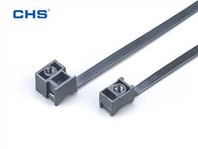
Hey there! As a supplier of Expand Plug Cable Ties, I often get asked all sorts of questions about our products. One question that pops up quite a bit is, "Are expand plug cable ties resistant to static electricity?" Let's dive into this topic and find out.
First off, let's understand what static electricity is. Static electricity is basically an imbalance of electric charges within or on the surface of a material. It happens when two objects come into contact and then separate, causing electrons to transfer from one object to the other. You've probably experienced it when you walk across a carpet and then get a shock when you touch a metal doorknob. That's static electricity in action!
Now, when it comes to expand plug cable ties, their resistance to static electricity depends on a few factors. The material they're made of plays a huge role. Most expand plug cable ties are made from nylon. Nylon is a common choice because it's strong, durable, and has good chemical resistance. But nylon isn't inherently resistant to static electricity.
In general, plastics like nylon tend to accumulate static charges. When they rub against other materials, electrons can be transferred, leading to a build - up of static electricity. This can be a problem in some industries, especially those where static can cause damage to sensitive electronic components.
However, we've got solutions! At our company, we offer expand plug cable ties that are treated to reduce static electricity. We use anti - static additives during the manufacturing process. These additives work by providing a conductive path for the static charges to dissipate. So, instead of the charges building up on the surface of the cable tie, they can flow away, reducing the risk of static discharge.
Let me give you an example of where anti - static expand plug cable ties are crucial. In the electronics manufacturing industry, static electricity can be a real nightmare. A single static discharge can fry a delicate microchip, leading to costly product failures. By using our anti - static expand plug cable ties, manufacturers can ensure that their cables are neatly organized without the risk of static - related damage.
Another industry where static resistance matters is the pharmaceutical industry. In cleanrooms, where strict hygiene and safety standards are in place, static electricity can attract dust and particles. This can contaminate the products being manufactured. Our anti - static expand plug cable ties help maintain a clean and static - free environment, which is essential for the production of high - quality pharmaceuticals.
Now, let's talk about some of the other types of cable ties we offer. We have Stainless Steel Pawl Cable Ties. These are great for heavy - duty applications. The stainless steel pawl provides a strong locking mechanism, ensuring that the cable tie stays in place even under high tension. And if you need a cable tie that can be mounted easily, check out our Saddle Mounting Cable Ties. They're designed to be attached to flat surfaces quickly and securely.
For applications where extra security is needed, we have Double Locking Cable Tie. These cable ties have two locking points, providing an added layer of protection against accidental loosening.
So, if you're in an industry where static electricity is a concern, don't worry. Our anti - static expand plug cable ties are here to save the day. Whether you're in electronics, pharmaceuticals, or any other field that requires static - free cable management, we've got you covered.
If you're interested in learning more about our expand plug cable ties or any of our other products, we'd love to hear from you. You can reach out to us to discuss your specific needs and requirements. We're always happy to help you find the right cable tie solution for your business.
In conclusion, while standard expand plug cable ties made of nylon aren't resistant to static electricity, our treated anti - static versions are. They offer a reliable solution for industries where static can cause problems. So, don't let static electricity hold you back. Choose our expand plug cable ties and experience the difference in cable management.


References
- "Static Electricity: Principles and Applications" by William R. Hosler
- "Plastics in Electronics: Properties and Applications" by John A. Brydson