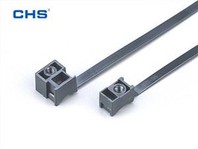
As a trusted supplier of Self Locking Cable Tie, I am often asked about the safety and potential emission of harmful substances from these useful products. In this blog post, I will delve into the scientific aspects to answer the question: Do self - locking cable ties emit any harmful substances?
Composition of Self - Locking Cable Ties
Most self - locking cable ties are made from nylon, commonly nylon 6 or nylon 6/6. Nylon is a synthetic thermoplastic polymer known for its strength, durability, and resistance to abrasion. The manufacturing process of nylon cable ties involves melting the nylon resin and then molding it into the desired shape of the cable tie.
Nylon itself is a relatively inert material under normal conditions. It has been used in a wide range of applications, from clothing to industrial components, for many years without significant reports of harm. The chemical structure of nylon consists of long - chain polymers with amide linkages. These polymers are stable and do not readily break down to release harmful substances.
Factors Affecting Substance Emission
Temperature
One of the main factors that could potentially cause self - locking cable ties to emit substances is high temperature. When nylon is exposed to extremely high temperatures, it can start to degrade. For example, nylon 6 has a melting point of around 220°C, and nylon 6/6 has a melting point of around 260°C. As the temperature approaches these melting points, the polymer chains begin to break down.
During the degradation process, small molecules may be released. These can include monomers, oligomers, and some volatile organic compounds (VOCs). However, in normal use, self - locking cable ties are rarely exposed to such high temperatures. They are typically used for bundling cables in indoor environments where the temperature is well below the degradation point.
Chemical Exposure
Exposure to certain chemicals can also affect the integrity of cable ties. Strong acids, bases, and some solvents can react with nylon and cause it to degrade. For instance, concentrated sulfuric acid can hydrolyze the amide linkages in nylon, leading to the breakdown of the polymer. But in most practical scenarios, cable ties are not in contact with such aggressive chemicals.
Scientific Studies on Emission
Scientific studies have been conducted to assess the potential emission of harmful substances from nylon products, including cable ties. These studies generally show that under normal usage conditions (ambient temperature and no chemical exposure), the emission of VOCs from nylon cable ties is extremely low.
A research project focused on the indoor air quality related to plastic products found that nylon materials, like those used in cable ties, contributed minimal amounts of VOCs to the indoor environment. The levels of these compounds were well below the safety limits set by international standards for indoor air quality.
Considerations for Special Applications
Cable Tie Handcuffs
In some security - related applications, cable ties are used as handcuffs. When used in this way, the cable ties are in direct contact with human skin. However, as long as the cable ties are made from high - quality nylon and comply with relevant safety standards, there is no significant risk of harmful substances being transferred to the skin. The materials used in these cable tie handcuffs are specially selected to ensure that they do not cause skin irritation or other adverse reactions.
Anti Skid Cable Tie
Anti - skid cable ties are designed with a special surface treatment to prevent slipping. This treatment usually involves adding a small amount of anti - slip agents. These agents are carefully chosen to be non - toxic and do not emit harmful substances. The anti - slip function is mainly achieved through the physical properties of the added materials, such as increasing friction, rather than through chemical reactions that could potentially release harmful substances.
Regulatory Compliance
To ensure the safety of self - locking cable ties, they are subject to various regulatory standards. For example, in the European Union, products must comply with the Restriction of Hazardous Substances Directive (RoHS). This directive restricts the use of certain hazardous substances, such as lead, mercury, cadmium, hexavalent chromium, polybrominated biphenyls (PBBs), and polybrominated diphenyl ethers (PBDEs) in electrical and electronic equipment. Since cable ties can be used in electrical applications, they need to meet these requirements.
In addition, many countries have their own standards for product safety and environmental protection. Our company, as a responsible supplier, always ensures that our Self Locking Cable Tie products meet or exceed these standards.
Conclusion
Based on the scientific evidence and engineering knowledge, under normal usage conditions, self - locking cable ties do not emit harmful substances. The nylon material they are made of is stable and inert, and the manufacturing processes and quality control measures ensure that the products are safe for a wide range of applications.
However, it is important to use cable ties within their recommended operating parameters. Avoid exposing them to extremely high temperatures or aggressive chemicals to maintain their integrity and safety.


If you are in the market for high - quality self - locking cable ties or have any questions about our products, we invite you to reach out for procurement discussions. Our team of experts is ready to assist you in finding the most suitable cable ties for your specific needs.
References
- ASTM International. "Standard Specification for Nylon Cable Ties." ASTM D3963 - 95 (Reapproved 2017).
- European Union. "Directive 2011/65/EU on the Restriction of the Use of Certain Hazardous Substances in Electrical and Electronic Equipment (RoHS)."
- Indoor Air Quality Research Project Report. [Publisher], [Year].