Are round head cable ties easy to install with one hand?
As a supplier of round head cable ties, I often get asked about the ease of installation, especially when it comes to one - hand operation. In various industries, the ability to install cable ties quickly and with minimal effort can significantly boost efficiency. So, let's delve into whether round head cable ties are user - friendly for one - handed installation.
Design Features Affecting One - Handed Installation
Round head cable ties have a distinct design that sets them apart from other types. The round head is engineered to provide a smooth surface, which can be an advantage during installation. When trying to install a cable tie with one hand, the shape of the head matters. Unlike sharp - edged or irregularly shaped heads, the round head is less likely to catch on clothing, gloves, or other objects in the workspace. This smoothness allows for a more fluid motion when guiding the cable tie through the bundle of wires or objects to be secured.
Another aspect of the design is the locking mechanism. Most round head cable ties use a ratchet - based locking system. This system is designed to allow the cable tie to be tightened easily in one direction while preventing it from loosening. For one - handed installation, the ratchet mechanism can be beneficial. With a simple pull of the tail of the cable tie, the ratchet engages, and the tie tightens around the bundle. This action can be performed relatively easily with one hand, as long as the user has a good grip on the cable tie.


Practical Considerations in One - Handed Installation
In real - world scenarios, the ease of one - handed installation depends on several factors. The size of the cable tie is a crucial factor. Smaller round head cable ties are generally easier to handle with one hand. They are lighter and more flexible, allowing for better control during the installation process. For example, a 4 - inch round head cable tie can be easily maneuvered with one hand to secure a small bundle of wires. On the other hand, larger cable ties, such as 18 - inch or 24 - inch ones, may require more effort and dexterity to install with one hand. The length and stiffness of the larger ties can make it challenging to guide them through a large bundle of wires without the assistance of the other hand.
The environment in which the installation takes place also plays a role. In a clean and organized workspace, one - handed installation of round head cable ties is more likely to be successful. There are fewer obstacles to interfere with the process, and the user can focus on the task at hand. However, in a cluttered or confined space, it may be more difficult to install the cable ties with one hand. For instance, in an electrical panel filled with wires and components, the limited space can make it hard to manipulate the cable tie without accidentally knocking into other parts.
Comparison with Other Types of Cable Ties
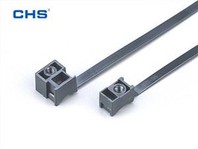
To better understand the ease of one - handed installation of round head cable ties, it's useful to compare them with other types. Holder Cable Ties are designed with a holder that can be attached to a surface. While they offer the advantage of being pre - positioned, the installation process may require two hands to secure the holder and then insert the cable tie. This can be less convenient for one - handed operation compared to round head cable ties.
Mounted Head Cable Ties are another type. These cable ties have a head that is designed to be mounted on a panel or other surface. Similar to holder cable ties, the mounting process often requires two hands to ensure proper alignment and attachment. In contrast, round head cable ties can be used more freely without the need for pre - mounting, making them more suitable for one - handed installation in many cases.
Anti Skid Cable Tie are designed to provide a more secure grip on the bundle of wires. While the anti - skid feature is useful for preventing the cable tie from slipping, it may also make the installation process a bit more difficult with one hand. The increased friction can require more force to pull the tail of the cable tie through the head, which can be challenging to achieve with just one hand.
Tips for One - Handed Installation of Round Head Cable Ties
If you're looking to install round head cable ties with one hand, here are some tips that can help. First, make sure you have a good grip on the cable tie. Hold the head of the cable tie between your thumb and index finger, with the tail extending out. This will give you better control over the tie as you guide it through the bundle of wires.
Next, try to position the bundle of wires in a way that makes it easy to insert the cable tie. If possible, use your body or a nearby surface to hold the bundle steady. This will free up your hand to focus on the installation process.
When pulling the tail of the cable tie to tighten it, use a smooth and steady motion. Avoid pulling too hard at once, as this can cause the cable tie to break or the ratchet mechanism to jam. Instead, pull the tail in small increments until the desired tightness is achieved.
Conclusion
In conclusion, round head cable ties can be relatively easy to install with one hand, especially when considering their design features such as the smooth round head and the ratchet - based locking mechanism. However, the ease of installation also depends on practical factors such as the size of the cable tie and the installation environment. Compared to other types of cable ties like holder cable ties, mounted head cable ties, and anti - skid cable ties, round head cable ties offer more flexibility for one - handed operation in many situations.
If you're in the market for high - quality round head cable ties or have any questions about their installation, we're here to help. Our team of experts can provide you with more information and guidance on choosing the right cable ties for your specific needs. We invite you to contact us to discuss your procurement requirements and start a productive business relationship.
References
- "Cable Tie Handbook", Industry Standard Publishing
- "Best Practices in Cable Management", Electrical Engineering Journal