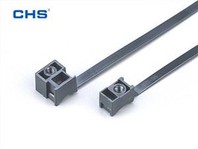
As a supplier of Self Locking Cable Ties, I'm often asked about the width of these essential fastening products. The width of self - locking cable ties is a crucial factor that impacts their performance, application range, and overall suitability for various tasks.
Understanding the Significance of Width
The width of a self - locking cable tie is directly related to its strength and durability. In general, wider cable ties are capable of withstanding greater tension forces. This means that they can securely hold heavier bundles of cables, wires, or other items without breaking or coming loose. For example, in industrial settings where thick power cables need to be organized and secured, wider cable ties are the preferred choice.
On the other hand, narrower cable ties are more flexible and ideal for use in applications where there is limited space or where only a small amount of tension is required. They can easily wrap around thin wires or delicate cables without causing damage. In electronics or telecommunications installations, where countless small wires need to be neatly arranged, narrower cable ties are commonly used.


Common Widths Available in the Market
Self - locking cable ties come in a range of standard widths. The most common widths are 2.5mm, 3.6mm, 4.8mm, and 6.4mm.
2.5mm Width
The 2.5mm wide self - locking cable ties are the thinnest and most flexible option. They are typically used for light - duty applications, such as organizing small cables in home entertainment systems, securing wires in model airplanes, or bundling up earphone cords. These ties are easy to handle and can be bent into tight spaces without breaking. With their small size, they are also aesthetically pleasing when used in visible areas. For instance, if you are setting up a home studio and want to keep the audio cables tidy, the 2.5mm cable ties will do the job discreetly.
3.6mm Width
A step up from the 2.5mm width, the 3.6mm cable ties offer a bit more strength. They are suitable for medium - duty tasks, such as cable management in office environments. In an office network, there are often a mix of Ethernet cables, power cords, and phone lines that need to be organized. The 3.6mm cable ties can hold these bundles together firmly without being too bulky. They are also commonly used in automotive wiring harnesses, where a moderate amount of tension is required to keep the wires in place.
4.8mm Width
The 4.8mm wide self - locking cable ties are quite versatile. They are frequently used in industrial and commercial settings. In manufacturing plants, they can be used to secure large machinery cables, preventing them from tangling and causing hazards. These cable ties are also popular in outdoor applications, such as in telecommunications towers. When it comes to bundling thick coaxial cables or multiple power cables in a tower, the 4.8mm cable ties provide the necessary strength and stability to withstand environmental factors like wind and vibration.
6.4mm Width
The widest of the common standard widths, the 6.4mm cable ties are designed for heavy - duty applications. They are capable of withstanding extremely high tension forces. In construction projects, for example, they can be used to secure large pipes or conduits. In power generation facilities, where thick cables are used to transmit high - voltage electricity, the 6.4mm cable ties are essential for keeping the cables safe and organized.
How to Choose the Right Width
Selecting the appropriate width of self - locking cable ties depends on several factors.
Weight and Size of the Items to be Bundled
The most obvious factor is the weight and size of the cables or objects you need to tie together. If you are bundling a large number of thick power cables, a wider cable tie like the 4.8mm or 6.4mm will be necessary. Conversely, if you are working with thin data cables or small wires, a 2.5mm or 3.6mm cable tie will suffice.
Application Environment
The environment in which the cable ties will be used is also important. In harsh outdoor environments, wider and more durable cable ties are recommended to withstand the elements. UV - resistant materials are often used in these cable ties to prevent degradation from sunlight. In indoor, climate - controlled environments, the choice of width can be more focused on the strength requirements rather than environmental resistance.
Installation Space
The available space for installation is another consideration. If you are working in a tight space, such as inside a computer case or a control panel, narrower cable ties will be easier to maneuver. In contrast, in open areas where there is plenty of room, wider cable ties can be used without any issues.
Related Products and Their Width Considerations
In addition to the standard self - locking cable ties, there are other types of cable ties that are related and have their own width considerations.
Double Locking Cable Ties
Double Locking Cable Ties offer enhanced security compared to regular self - locking cable ties. They have a double - locking mechanism that provides extra strength and prevents the tie from coming loose. These cable ties come in similar widths as the standard self - locking ones. However, due to their enhanced locking feature, they are often used in applications where the security of the bundle is of utmost importance, such as in aerospace or military equipment. The choice of width for double - locking cable ties follows the same principles as for standard self - locking cable ties, depending on the weight and size of the items to be bundled and the application environment.
Saddle Mounting Cable Ties
Saddle Mounting Cable Ties are designed to be mounted on a surface, such as a wall or a panel. They are commonly used in electrical installations to secure cables in a fixed position. The width of saddle - mounting cable ties can vary, and the selection depends on the type and size of the cables they need to hold. For example, if you are mounting a single thick power cable on a wall, a wider saddle - mounting cable tie will provide better support.
Conclusion
The width of self - locking cable ties is a key characteristic that determines their functionality and suitability for different applications. Whether you need a thin and flexible tie for small - scale projects or a wide and strong one for heavy - duty tasks, understanding the significance of width is essential. As a supplier of Self Locking Cable Ties, we offer a comprehensive range of cable ties in various widths to meet your specific needs.
If you are in the market for self - locking cable ties or any related products, we encourage you to reach out to us for more information. Our team of experts is ready to provide guidance on the best width and type of cable ties for your application. We understand that every project is unique, and we are committed to helping you find the perfect solution for your cable management needs.
References
- Cable Tie Handbook: A Guide to the Selection and Use of Cable Ties.
- Industry Standards for Plastic Fasteners and Cable Ties.