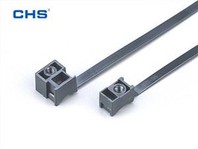
What is the Elasticity of Beaded Cable Ties?
As a reputable supplier of beaded cable ties, I've witnessed firsthand the diverse applications and the critical role these ties play in various industries. Elasticity is a fundamental property that affects their performance, durability, and suitability for different tasks. In this blog post, I'll delve into the concept of elasticity in beaded cable ties, exploring its importance, how it's measured, and factors that influence it.


Understanding Elasticity
Elasticity refers to the ability of a material to deform under stress and return to its original shape when the stress is removed. In the context of beaded cable ties, this property determines how well they can stretch to accommodate different bundle sizes and then maintain a secure hold. A highly elastic cable tie can expand to fit around a larger group of wires or cables without breaking, and then contract to provide a tight, stable connection.
The elasticity of beaded cable ties is crucial for several reasons. Firstly, it allows for flexibility in installation. When dealing with irregularly shaped bundles or a varying number of cables, an elastic tie can easily adapt to the specific requirements. This flexibility reduces the need for multiple sizes of cable ties, simplifying inventory management and installation processes.
Secondly, elasticity contributes to the longevity of the cable ties. A tie that can stretch and contract without losing its integrity is less likely to break or become brittle over time. This durability ensures that the cables remain securely fastened, even in environments with temperature fluctuations, vibrations, or mechanical stress.
Measuring Elasticity
The elasticity of beaded cable ties is typically measured using a parameter called the elastic modulus. The elastic modulus is a measure of the stiffness of a material and is defined as the ratio of stress to strain within the elastic range. Stress refers to the force applied to the cable tie, while strain is the resulting deformation or change in length.
To measure the elastic modulus of a beaded cable tie, a sample is subjected to a gradually increasing tensile force until it reaches its elastic limit. The force and the corresponding change in length are recorded, and the elastic modulus is calculated using the formula:
Elastic Modulus (E) = Stress (σ) / Strain (ε)
A higher elastic modulus indicates a stiffer material, while a lower modulus suggests a more elastic one. For beaded cable ties, an optimal elastic modulus is one that provides sufficient flexibility for installation while maintaining enough stiffness to hold the cables securely.
Factors Affecting Elasticity
Several factors can influence the elasticity of beaded cable ties. One of the most significant factors is the material used in their construction. Common materials for cable ties include nylon, polyester, and polypropylene, each with its own unique elastic properties.
Nylon is a popular choice for beaded cable ties due to its high strength, durability, and good elasticity. It can withstand a wide range of temperatures and has excellent resistance to chemicals and UV radiation. Polyester, on the other hand, offers even higher strength and is more resistant to abrasion and cutting. However, it may have slightly lower elasticity compared to nylon. Polypropylene is a lightweight and cost - effective option, but it generally has lower strength and elasticity than nylon and polyester.
The manufacturing process also plays a role in determining the elasticity of the cable ties. Factors such as the extrusion temperature, cooling rate, and the addition of additives can all affect the molecular structure of the material and, consequently, its elastic properties. For example, a slower cooling rate during the extrusion process can result in a more ordered molecular structure, which may increase the elasticity of the cable tie.
The design of the beaded cable tie can also impact its elasticity. The shape and size of the beads, as well as the spacing between them, can affect how the tie stretches and contracts. A well - designed beaded cable tie will have beads that are evenly spaced and sized to allow for smooth and uniform stretching, while still providing enough resistance to prevent the tie from slipping off the cables.
Applications and Elasticity Requirements
The elasticity requirements of beaded cable ties vary depending on their intended applications. In the electronics industry, for example, cable ties are often used to organize and secure wires within electronic devices. In this case, a high degree of elasticity is desirable to allow for easy installation and removal of the ties, especially when working with delicate components. The ties should be able to stretch to fit around the wires without causing damage to the insulation.
In the automotive industry, beaded cable ties are used to secure wiring harnesses, hoses, and other components. Here, the ties need to have sufficient elasticity to withstand the vibrations and movements associated with vehicle operation. They also need to maintain a secure hold over a long period of time, even in harsh environmental conditions such as extreme temperatures and exposure to chemicals.
In the construction industry, cable ties are used for a variety of purposes, including bundling pipes, securing scaffolding, and organizing electrical cables. For these applications, the ties need to be strong and have good elasticity to handle the heavy loads and rough handling often encountered on construction sites.
Comparing with Other Types of Cable Ties
When considering the elasticity of beaded cable ties, it's useful to compare them with other types of cable ties available in the market. Dual Lock Cable Ties are designed with a unique locking mechanism that provides a high level of security. While they may not have the same level of elasticity as beaded cable ties, they are ideal for applications where a permanent and secure connection is required.
Metal Detectable Cable Ties are used in industries such as food processing and pharmaceuticals, where the presence of foreign objects needs to be detected. These ties are made from materials that contain metal particles, which can be detected by metal detectors. Their elasticity is similar to that of standard nylon cable ties, but they offer an additional safety feature.
Releasable Push Mount Cable Ties are designed for easy installation and removal. They have a push - mount design that allows them to be quickly attached and detached from surfaces. While they may not have the same level of elasticity as beaded cable ties, they are very convenient for applications where frequent access to the cables is required.
Contact for Procurement
If you're in the market for high - quality beaded cable ties or have any questions about their elasticity and suitability for your specific applications, I encourage you to reach out to me. I have a wide range of beaded cable ties available, with different elastic properties and designs to meet your needs. Whether you're in the electronics, automotive, construction, or any other industry, I can provide you with the right cable ties for your project. Let's start a conversation about your procurement requirements and find the best solutions together.
References
- Callister, W. D., & Rethwisch, D. G. (2018). Materials Science and Engineering: An Introduction. Wiley.
- Ashby, M. F., & Jones, D. R. H. (2012). Engineering Materials 1: An Introduction to Properties, Applications, and Design. Butterworth - Heinemann.