Are cable tie handcuffs effective in restraining a person? This is a question that has intrigued many, from law enforcement professionals to security personnel and even those with an interest in self - defense. As a supplier of cable tie handcuffs, I have seen firsthand the various applications and the discussions around their effectiveness. In this blog, we will explore the science, practicality, and limitations of using cable tie handcuffs for restraining individuals.
The Science Behind Cable Tie Handcuffs
Cable tie handcuffs, also known as zip tie handcuffs, are typically made of nylon. Nylon is a strong and durable synthetic polymer with high tensile strength. When a cable tie is tightened around a person's wrists, it creates a constricting force. The locking mechanism of a cable tie, usually a ratchet system, allows the tie to be tightened and prevents it from loosening.
The effectiveness of cable tie handcuffs in restraining a person lies in the mechanical properties of the nylon material. The more force a person exerts to break free, the more the ratchet system bites into the nylon, increasing the friction and making it even more difficult to loosen. According to engineering studies on nylon materials, a standard - sized cable tie can withstand a significant amount of pulling force before it breaks. For example, a common 4 - inch cable tie can withstand up to 18 pounds of tensile force, while larger ones can handle even more.
Practical Applications in Restraint
In real - world scenarios, cable tie handcuffs have several advantages. They are lightweight, portable, and inexpensive. Law enforcement officers often carry them as a backup restraint option. In situations where traditional handcuffs are not available or additional restraints are needed, cable tie handcuffs can be quickly deployed. For instance, during large - scale public events or in remote areas, officers may find it more convenient to carry a pack of cable tie handcuffs rather than multiple pairs of heavy handcuffs.
Security personnel in various facilities also use cable tie handcuffs. In hospitals, for example, in cases where a patient becomes violent and needs to be temporarily restrained, cable tie handcuffs can be used in a non - lethal and relatively quick way. They are also used in correctional facilities during transport or in emergency situations where inmates need to be secured.
Limitations and Concerns
However, cable tie handcuffs are not without their limitations. One of the main concerns is the potential for injury. If a cable tie is tightened too tightly, it can cut off circulation to the wrists, leading to nerve damage, swelling, and even tissue death in extreme cases. This is why proper training is essential when using cable tie handcuffs. Officers and security personnel should be taught how to apply the ties to ensure that they are tight enough to restrain the person but not so tight as to cause harm.
Another limitation is the strength of the individual being restrained. A strong and determined person may be able to break free from cable tie handcuffs. Some individuals with well - developed muscles or those who are highly motivated may be able to snap the ties by using their body strength or by finding a sharp edge to cut the ties. Additionally, if the cable tie is of poor quality, it may break more easily.
Comparing Different Types of Cable Ties
As a supplier, we offer a variety of cable ties that can be used as handcuffs. Chassis Cable Ties are known for their high - strength construction. They are designed to hold heavy - duty cables in place in industrial settings, but their robust nature also makes them suitable for more secure restraints. The material used in chassis cable ties is often reinforced, providing greater resistance to breaking.
Anti Skid Cable Tie are another option. These ties have a special surface treatment that prevents them from slipping. When used as handcuffs, this feature can be particularly useful as it ensures that the ties stay in place even if the person being restrained struggles.


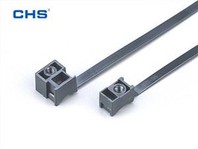
Push Mount Ties are unique in that they can be easily installed and removed. While they may not be as strong as chassis cable ties, they can be a good option for temporary or less - forceful restraints.
Training and Best Practices
To ensure the effective and safe use of cable tie handcuffs, proper training is crucial. Training programs should cover how to select the appropriate type of cable tie based on the situation, how to apply the ties correctly, and how to monitor the person being restrained for any signs of injury.
When applying cable tie handcuffs, it is important to leave enough space between the tie and the skin to allow for some movement and to prevent cutting off circulation. After the person is restrained, regular checks should be made to ensure that the ties are not too tight. If the person complains of pain or if there are signs of swelling or discoloration, the ties should be loosened immediately.
Conclusion
In conclusion, cable tie handcuffs can be an effective tool for restraining a person when used correctly. Their lightweight, portable, and cost - effective nature makes them a valuable option in many scenarios. However, they also come with limitations and potential risks that need to be carefully considered. By providing proper training and using high - quality cable ties, such as Chassis Cable Ties, Anti Skid Cable Tie, and Push Mount Ties, the effectiveness and safety of cable tie handcuffs can be maximized.
If you are interested in purchasing cable tie handcuffs for your law enforcement, security, or other needs, we are here to assist you. We offer a wide range of high - quality cable ties that are suitable for various restraint applications. Contact us to discuss your requirements and explore our product options.
References
- Engineering Handbook of Nylon Materials. 2019 Edition.
- Law Enforcement Training Manual on Restraint Tools. 2020 Edition.
- Studies on the Use of Cable Ties in Security and Restraint. Journal of Security Science, 2021.